
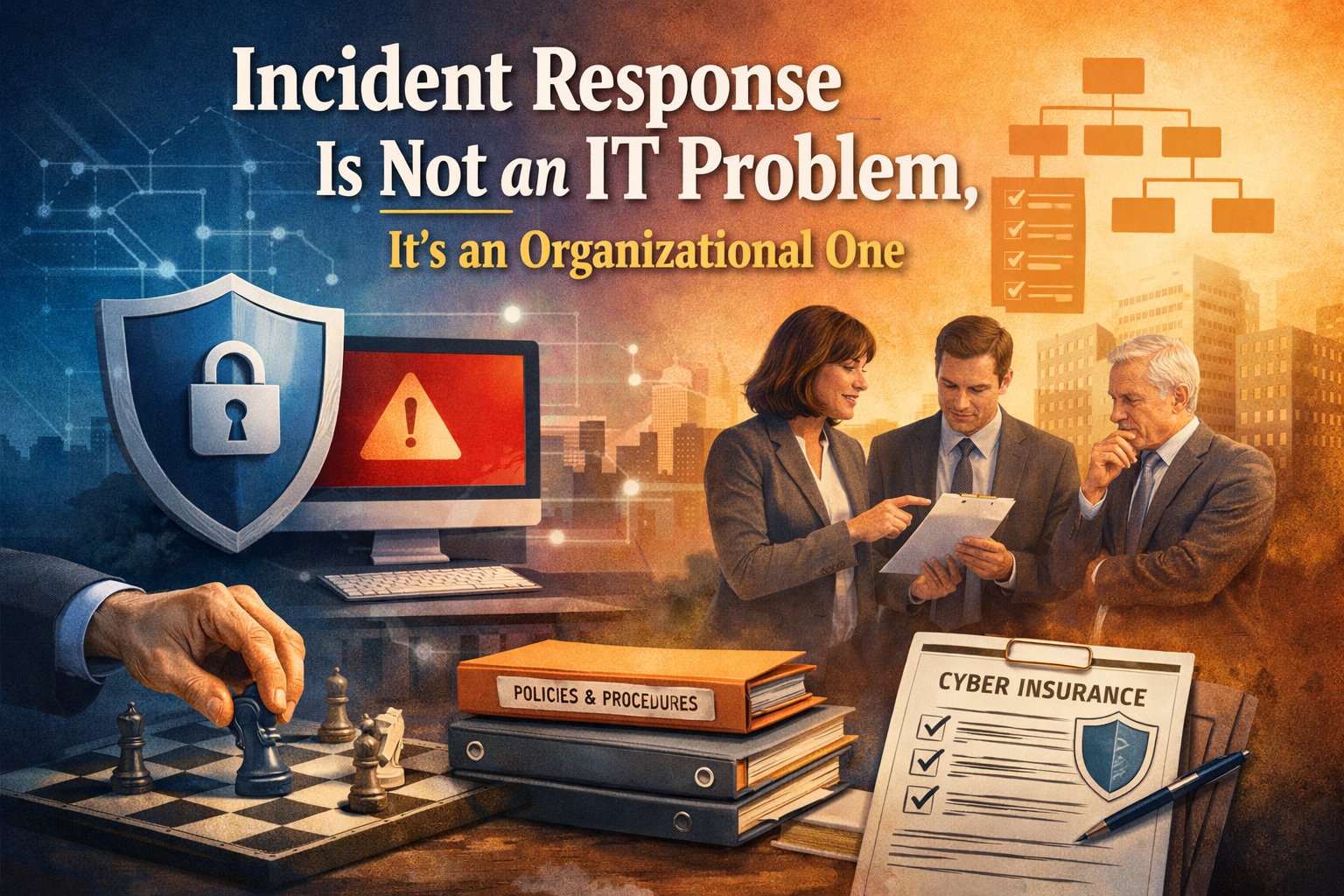
Incident Response Is Not an IT Problem, It’s an Organizational One
Click here to view/listen to our blogcast.
When organizations think about incident response, the conversation often starts and ends with technology. Firewalls, email security, backups, endpoint protection, and monitoring tools usually dominate the discussion. But in real incidents, technology is rarely the deciding factor. What determines the outcome is how quickly people recognize a problem, who is empowered to act, how decisions are made, and whether there is a clear, documented response process that extends beyond IT.
Incident response is not an IT problem. It is an organizational one.
Where Incident Response Actually Breaks Down
Many organizations operate under the belief that if something serious happens, they will figure it out as they go. That belief is rarely examined until it is tested under pressure and then the common failure points include:
- Uncertainty about who owns incident-related decisions beyond IT.
- Hesitation around when and how to notify internal stakeholders.
- Concern among staff about escalating issues unnecessarily.
- Important decisions occurring through informal or ad hoc conversations.
- Leadership involvement beginning only after a situation becomes urgent.
Technology may signal that something is wrong, but it cannot resolve uncertainty, assign responsibility, or make judgment calls on behalf of the organization.
Modern Incidents Are Not Always Technical
Many of today’s most damaging incidents do not involve malware, system outages, or obvious technical failures. Instead, they involve social engineering, payment diversion, impersonation, and manipulation of normal business workflows. These incidents are dangerous precisely because they look routine.
- A believable invoice.
- A message that appears to come from leadership.
- A request that seems urgent but reasonable.
- A conversation that feels like it is already in progress.
- An AI-generated voice call or video message that appears to come from a trusted executive or partner, adding urgency and false credibility.
In these situations, people are often acting in good faith, trying to be responsive, helpful, and efficient. Without clear guidance, verification steps, and escalation paths, even experienced staff can be placed in difficult positions. This is why modern incident response planning must account for human judgment under pressure and ensure that employees know when to pause, verify, and involve others, rather than feeling they must handle the situation alone.
Why Incident Response Must Involve the Entire Organization
Effective incident response requires coordination across multiple roles, not just technical staff. A well-designed incident response plan answers questions such as:
- Who has authority to approve or halt payments?
- Who verifies requests that appear to come from executives?
- Who communicates internally during an incident?
- When should legal, finance, or leadership be involved?
- How are incidents documented and reviewed afterward?
Without clear answers, organizations default to improvisation, and improvisation is where mistakes happen.
Technology Supports Response, It Does Not Replace It
Security tools play an important role, but they are only one layer of defense. Even the best tools cannot:
- Interpret intent in a well-crafted message.
- Decide whether a request makes business sense.
- Understand organizational context.
- Replace human judgment during ambiguous situations.
This is why effective incident response planning must give equal attention to people, process, and technology. Plans should acknowledge how real people work under stress, provide clear guidance instead of assumptions, and create shared understanding across roles, so individuals are supported by structure rather than left to rely on instinct when it matters most.
How CDML Can Help
Incident response failures rarely happen because of missing technology. They happen when people are unsure what to do, who to notify, or how to verify requests under pressure.
CDML Computer Services helps organizations reduce that risk by:
- Reviewing real-world threat scenarios, including payment diversion and executive impersonation emails.
- Designing and documenting incident response plans that clearly define roles, escalation paths, and decision authority.
- Aligning IT, leadership, accounting, and operations around a shared response process.
- Implementing email security controls to reduce the volume of malicious and deceptive messages reaching users.
- Providing ongoing email and cybersecurity awareness training so staff can recognize social engineering tactics and know when and how to escalate suspicious messages.
- Working with a trusted cyber insurance broker to help organizations qualify for cyber insurance policies by aligning controls, documentation, and response plans with insurer requirements, helping secure coverage at more affordable rates.
- Running periodic tabletop exercises and scenario reviews to ensure plans work in practice, not just on paper.
- Regularly reviewing and updating response plans as threats, staff roles, and business operations evolve.
Final Thoughts
Incident response is not about reacting faster to technology failures. It is about ensuring that when something unexpected happens, the organization responds deliberately instead of instinctively. The most effective incident response plans are not written for IT teams alone. They are designed for the entire organization, because incidents rarely respect departmental boundaries.
If you are not sure how your organization would respond under pressure, that uncertainty itself is a risk worth addressing and the CDML team is here to help.
Stay safe. Stay informed. Stay compliant.

📞 Contact us here: https://cdml.com/contact/
📚 Read more on our blog: https://cdml.com/blog-2
📺 Listen to our blogcasts: https://www.youtube.com/@CDMLComputerServices